Trade finance still depends heavily on paper. Letters of credit, bills of lading, invoices, and certificates of origin move between banks, shipping lines, importers, exporters, and customs authorities. Most travel as physical documents or PDFs. Each party maintains its own records, reconciliation stays manual, and the process remains slow, expensive, and open to fraud.
When blockchain first entered the picture, it seemed like a natural fit. A shared ledger could replace fragmented records. Smart contracts could automate checks. Cryptographic proof could guarantee document integrity. As a result, several major platforms launched between 2018 and 2021 to deliver on that promise.
Most of those platforms have since shut down. TradeLens, we.trade, Marco Polo, and Contour all ceased operations or entered insolvency. Yet the underlying problems remain. At the same time, a second wave of more focused tools is gaining real traction. This post examines what happened, what we can learn, and where distributed ledger technology (DLT) delivers measurable results today.
The analysis draws on an episode of On The Block, Espeo Software‘s series on blockchain and decentralised technology. Espeo Software is a blockchain consultancy specialising in payments, asset tokenisation, and DLT projects for financial institutions.
What changed after the first wave
Between roughly 2016 and 2022, the trade finance industry invested heavily in blockchain-based platforms. The idea was ambitious: connect banks, logistics operators, customs authorities, and corporates on shared ledgers. The goal was to digitise the entire journey from purchase order to shipment to payment. Early pilots seemed to confirm the thesis. Blockchain-based letters of credit cut processing times from days to hours, and shared visibility simplified audits.
However, the shift from pilot to production-scale network proved far harder than the technology alone would suggest. By the end of 2022, several high-profile platforms had shut down or restructured. As a result, the question facing the industry in 2026 is not whether DLT in trade finance failed. Instead, the question is whether it has changed shape – and what the second wave looks like.
Why trade finance still runs on paper and PDFs
Too many parties, too many systems
To understand why blockchain looked like a fit, consider why trade finance digitisation has been so difficult. A single letter of credit transaction can involve ten or more parties. These include the importer, exporter, issuing bank, advising bank, confirming bank, freight forwarder, carrier, customs broker, insurer, and inspection agency. Each holds its own version of the relevant documents. Moreover, each uses different systems, formats, and reconciliation processes.
The bill of lading bottleneck
The bill of lading – the document that proves ownership of a shipment – often has to travel physically from port to port. If it arrives late, cargo sits at the terminal and racks up storage costs. If someone forges or duplicates it, the consequences can be severe. Multiple parties may believe they control the same goods.
Invoices and certificates face similar risks. Consequently, the result is a workflow that costs too much to operate, takes too long to execute, and stays open to disputes and fraud. This includes the persistent problem of duplicate financing, where the same goods or invoices get pledged to multiple lenders.
Why blockchain looked like a fit
The core appeal of blockchain for trade finance was straightforward. First, a shared ledger gives all authorised parties access to the same document or transaction record. This eliminates the need for each party to reconcile separately. Second, cryptographic hashing ensures that no one can alter a record without detection. Third, permissioned access controls let organisations share data selectively. Finally, smart contracts can automate conditional logic – for example, triggering a payment notification when shipping documents confirm dispatch.
“Put the key documents and key events on a shared ledger. Make them tamper-proof and visible to all the parties who need to see them. And then use smart contracts to automate checks and payments.”
– On The Block, Espeo Software
In theory, this combination of document integrity, shared visibility, and automation addressed the core pain points of trade finance. The early pilots confirmed the technical premise. Teams digitised documents, shortened processing times, and improved audit trails.
What early pilots proved and where scale was harder
The first blockchain-based letters of credit showed that the technology worked in controlled settings. Processing times dropped significantly. Shared data cut reconciliation effort. Auditors could trace document histories more easily. These results were real, but teams achieved them in environments with few pre-aligned participants, limited document types, and defined trade corridors.
Scaling from a pilot with five banks and one trade lane to a global network with hundreds of institutions introduced challenges that were not primarily technical. For instance, integration with legacy systems cost a great deal. Onboarding new participants required custom work. In addition, the business case for each participant depended on how many others were already on the platform. This created a classic network-effects problem: nobody wanted to go first, but everyone wanted to go second.
The platform era: TradeLens and trade finance consortia
The most ambitious first-wave projects tried to build industry-wide platforms. TradeLens, developed by Maersk and IBM, aimed to become a global logistics operating system. It onboarded many ports and customs authorities and processed real shipping data. However, in November 2022, Maersk and IBM announced its discontinuation. They cited a failure to achieve “full global industry collaboration” and the commercial viability needed to sustain an independent business.
we.trade, a consortium of European banks built on Hyperledger Fabric, sought to digitise trade finance for small and medium enterprises. It connected a group of banks across multiple countries but struggled to reach meaningful transaction volumes. As a result, it entered liquidation in 2022.
Marco Polo, a network of approximately 45 banks built on R3’s Corda platform, offered receivables finance and payables finance on a shared ledger. It filed for insolvency in 2023. Similarly, Contour, focused on digitising letters of credit, also ceased operations after failing to convert pilot activity into sustained commercial volume.
we.trade – Liquidation, 2022. European bank consortium for SME trade finance.
TradeLens – Discontinued November 2022. Maersk and IBM global logistics platform.
Marco Polo – Insolvency, 2023. ~45-bank network for receivables and payables finance.
Contour – Operations ceased. Letter of credit digitisation network.
Why many networks did not reach scale
The recurring patterns across these closures tell a clear story. They point not to limitations of DLT as a technology, but to problems with economics, governance, and incentive structures in multi-party networks.
Governance and neutrality
When a platform is closely linked to one dominant player – whether a carrier, a bank, or a technology vendor – competitors hesitate to join. TradeLens faced this directly. Other carriers worried about participating in a platform closely tied to Maersk. Even when the technology worked well, the perception of unequal control slowed adoption.
“Who controls the network matters as much as what runs under the hood, even if it is decentralised. If competitors feel that one player has too much power, they will hesitate to join no matter how good the technology is.”
– On The Block, Espeo Software
Economics and the chicken-and-egg problem
Building a trade finance consortium requires significant upfront investment in technology, integration, and onboarding. But the value only materialises at scale. And scale only comes when enough participants are active. As a result, several platforms found themselves in a cycle. Insufficient volume made it hard to justify continued investment. At the same time, insufficient investment made it hard to attract volume.
Integration effort
Each bank or logistics operator connecting to a platform had to integrate its own systems. These include core banking, trade finance modules, document management, and compliance engines. Without shared standards for data models and application programming interfaces (APIs), every new participant connection became a separate project. This made onboarding slow and expensive.
Displacement of intermediaries
Digitisation often shifts who does the work and who earns the revenue. Platforms that cut out intermediaries – such as document couriers, manual checkers, or paper processors – without offering those parties a new role met active resistance.
“If your platform cuts out intermediaries without giving them a new role, don’t be surprised if they try to block it.”
– On The Block, Espeo Software
Second wave pattern 1: electronic bills of lading (eBL)
Why the bill of lading matters most
The most visible success in the second wave of trade finance digitisation is the electronic bill of lading (eBL). Rather than trying to digitise all trade documents at once, the eBL targets a single document with outsized importance.
A bill of lading serves three functions simultaneously. First, it acts as a receipt confirming that the carrier has received the goods. Second, it records the terms of the contract of carriage. Third, and most critically, it functions as a document of title. Whoever holds the bill of lading controls the cargo. This title function makes the bill of lading central to trade finance. Banks finance shipments against it, and possession determines who can claim the goods.
Where eBL stands today
Multiple eBL platforms are now live. They allow shippers, carriers, and banks to issue, transfer, and surrender bills of lading digitally. Some of these platforms use blockchain under the hood. This ensures singularity (only one valid copy exists at any time), integrity (no one can alter the document), and traceability (the full chain of transfers stays on record). Volumes are still small compared with the total market, but they are growing steadily.
In February 2023, the nine carrier members of the Digital Container Shipping Association (DCSA) committed to converting 50% of their bills of lading to digital within five years. They also pledged 100% eBL adoption by 2030. According to DCSA, switching from paper could save USD 6.5 billion in direct costs. It could also enable USD 30-40 billion in annual global trade growth. By late 2024, a FIT Alliance survey showed that nearly half of respondents were already using eBLs in some capacity.
Focused scope: One document, one problem. Easier to explain, integrate, and justify in a business case.
Clear value: Cuts processing time from days to minutes. Eliminates courier costs and late-arrival delays.
Carrier-driven adoption: When the companies that move the cargo commit to change, banks and insurers follow.
Legal backing: New laws in multiple jurisdictions now recognise eBLs as legally equivalent to paper.
Second wave pattern 2: duplicate financing validation
The hidden fraud problem
One of the persistent fraud risks in trade finance is duplicate financing. This occurs when someone pledges the same invoice, shipment, or set of documents to two or more lenders simultaneously. Because lenders typically cannot see each other’s financing positions, detecting this fraud is difficult. It often surfaces only when a default triggers recovery efforts.
How validation registries work
The solution gaining traction is a validation registry model. Banks submit hashed “fingerprints” of financing documents to a central registry. The registry then compares each new submission against existing records and flags potential matches. Importantly, it does not reveal the underlying data or the identity of other lenders. This preserves competitive confidentiality while enabling cross-institutional fraud detection.
The most prominent implementation is the Trade Financing Validation Service, developed by MonetaGo. The Society for Worldwide Interbank Financial Telecommunication (SWIFT) distributes it through its API channel. After a pilot involving 20 institutions across four continents, the service now reaches all 11,000+ institutions on the SWIFT network. Banks access it via existing APIs. There is no need to join a new platform or adopt a new ledger.
“Banks can access such services via existing APIs and networks such as SWIFT. No need to join a big new platform. That’s a very different go-to-market model.”
– On The Block, Espeo Software
This approach illustrates a broader lesson. Focused tools that plug into existing infrastructure face lower adoption barriers than platforms that require participants to migrate to a new environment.
What is enabling adoption now: law, standards, and APIs
Three structural changes are now reducing the friction that held back first-wave projects.
Legal recognition of electronic trade documents
Many early blockchain projects tried to digitise documents that, in law, still had to exist on paper. For example, under English law prior to 2023, an electronic document could not be “possessed.” This meant it could not function as a document of title. As a consequence, banks could not confidently finance against it, and carriers could not rely on it for cargo release.
The UK Electronic Trade Documents Act 2023 changed this when it came into force in September 2023. It grants electronic trade documents the same legal status as their paper equivalents. However, the documents must sit on a “reliable system” that ensures singularity, integrity, and exclusive control. Notably, the Act does not specify any particular technology. Both blockchain-based systems and other approaches can qualify.
The MLETR framework for global adoption
At the international level, the United Nations Commission on International Trade Law (UNCITRAL) Model Law on Electronic Transferable Records (MLETR) provides a framework for countries to enact similar legislation. UNCITRAL adopted it in 2017. The law builds on functional equivalence: an electronic record can serve the same legal function as a paper document if it meets requirements for control, identification, and integrity.
As of early 2026, 11 jurisdictions have adopted legislation based on or influenced by MLETR. These include the UK, Singapore, France, and Bahrain. In addition, Australia is progressing its own MLETR-aligned legislation.
Note: This section provides general context on legal developments. It does not constitute legal advice. Organisations should consult qualified legal counsel on the enforceability of electronic trade documents in relevant jurisdictions.
Industry standards for data and APIs
If every platform defines its own data model for a bill of lading or an invoice, every integration becomes a separate project. Fortunately, the industry has made significant progress in solving this.
The International Chamber of Commerce (ICC) Digital Standards Initiative (DSI) has published its Key Trade Documents and Data Elements (KTDDE) framework. This work analyses all 36 key trade documents from the WTO-UNCITRAL-ESCAP Cross-border Paperless Trade Toolkit. As a result, the KTDDE provides a harmonised data model and glossary, offering a practical foundation for interoperability between platforms.
Meanwhile, the DCSA has released open-source API standards for booking, shipping instructions, and the bill of lading. These standards define how platforms should exchange data. This matters because when carriers adopt standardised APIs, banks, freight forwarders, and customs authorities can integrate once. They no longer need custom connections to each carrier’s system.
The evolving settlement layer
Payment and settlement are also shifting. For instance, Project Agora, led by the Bank for International Settlements (BIS), brings together seven central banks and over 40 financial institutions. They are exploring how tokenised commercial bank deposits and tokenised wholesale central bank money can operate on a shared programmable platform. If these experiments mature, they could enable 24/7 cross-border settlement with finality. Over time, such systems could plug directly into digital trade workflows.
The new model: a “network of networks”
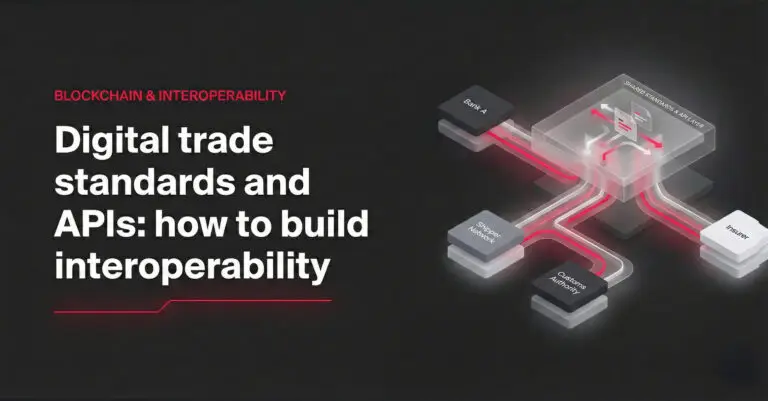
The emerging architecture for digital trade finance is not a single global platform. Instead, it is a network of networks. Specialised systems each address a defined function and connect to one another through standards and APIs.
How the pieces fit together
In this model, a bank can adopt an eBL platform for document handling. It can use the SWIFT-MonetaGo service for duplicate financing checks. And it can connect to tokenised settlement infrastructure for cross-border payments. Crucially, it does not need to commit to a single end-to-end platform. Each component can be evaluated, adopted, and replaced independently. This reduces both vendor lock-in and governance risk.
“We are not going back to the one global platform that solves everything. Instead, we will see a network of networks. Some will focus on documents, some will focus on fraud and risk, some will focus on payments and settlements. And they will talk to each other through standards and APIs.”
– On The Block, Espeo Software
What this means for your organisation
For organisations planning their own digital trade initiatives, this model suggests a practical approach. Start with one painful document or one defined risk. Choose tools built on open standards. And above all, ensure that whatever you build or procure can interoperate with the broader ecosystem.
Frequently Asked Questions
Not in a blanket sense. Several large consortium platforms did not reach the adoption levels needed for commercial viability. However, the underlying technology continues to deliver value in focused applications. For example, electronic bill of lading platforms and duplicate financing validation registries are live and growing. The key lesson is that focused tools addressing a single document or risk scale more readily than broad platforms.
Maersk and IBM announced the discontinuation of TradeLens in November 2022. They stated that the platform had not achieved the level of global industry collaboration needed for commercial viability. In particular, competing carriers were reluctant to join a platform closely linked to one dominant carrier. The technology itself worked, but the governance model did not support broad adoption.
An electronic bill of lading is a digital equivalent of the paper bill of lading. This document serves as a receipt for shipped goods, a record of carriage terms, and a document of title (meaning whoever holds it controls the cargo). eBL platforms ensure that only one valid copy exists at any time and that no one can alter it. Interoperability between different eBL platforms is critical for broad adoption, and bodies such as DCSA are developing standards to enable this.
The nine carrier members of DCSA have committed to 50% digital bill of lading issuance within five years and 100% by 2030. A late-2024 FIT Alliance survey showed that nearly half of respondents already used eBLs in some form. However, adoption will likely proceed corridor by corridor and carrier by carrier. Legal recognition in the relevant jurisdictions remains a prerequisite for each corridor.
Banks can use validation registries that compare hashed “fingerprints” of financing documents against existing records. The most prominent example is the SWIFT-distributed Trade Financing Validation Service, powered by MonetaGo. It allows banks to check new financing requests without revealing competitor data. Because the service runs on the SWIFT network, banks can integrate it into existing workflows without joining a new platform.
The UNCITRAL Model Law on Electronic Transferable Records (MLETR) provides a template for national legislation. It gives electronic trade documents – such as bills of lading, bills of exchange, and promissory notes – the same legal standing as their paper equivalents. The law builds on functional equivalence and remains technology-neutral. As of early 2026, 11 jurisdictions have adopted MLETR-based legislation. Organisations should monitor progress in the jurisdictions where they trade.
Two frameworks stand out. The ICC Digital Standards Initiative (DSI) Key Trade Documents and Data Elements (KTDDE) provides a harmonised data model for 36 key trade documents. In addition, DCSA publishes open-source API standards for bill of lading and booking processes. Together, these reduce integration costs by giving platforms a common specification. Standards-based integration is now a precondition for interoperability in the “network of networks” model.
Further Reading
- Maersk press release on TradeLens discontinuation – The official November 2022 statement on the decision to withdraw TradeLens and the reasons behind it.
- DCSA 100% eBL commitment – Details of the nine-carrier commitment to full electronic bill of lading adoption by 2030, including standards and adoption resources.
- UK Electronic Trade Documents Act 2023 – Full text of the legislation granting electronic trade documents the same legal status as paper under English law.
- Law Commission: Electronic trade documents project – Background, analysis, and recommendations that informed the UK Act.
- UNCITRAL Model Law on Electronic Transferable Records (MLETR) – The model law text, explanatory notes, and current adoption status across jurisdictions.
- ICC Digital Standards Initiative – Our Work – Overview of the KTDDE framework, key trade data glossary, and reliability assessment framework.
- SWIFT Trade Finance Validation Service (MonetaGo) – Technical overview and API documentation for the duplicate financing validation service.
- BIS Project Agora – Details on the multi-currency unified ledger initiative exploring tokenised cross-border settlement.
- DCSA Electronic Bill of Lading standard – Technical standards and API specifications for eBL implementation and interoperability.
This post is based on an episode of On The Block, Espeo Software’s series on blockchain and decentralised technology. Direct quotes have been lightly edited for readability.