Estimated read: 7 minutes
Your passport should never become an NFT. Your identity should not be a token. But the rights your identity unlocks? That’s where tokenization gets interesting — and it’s the key to understanding the EU Digital Identity Wallet (EUDI Wallet).
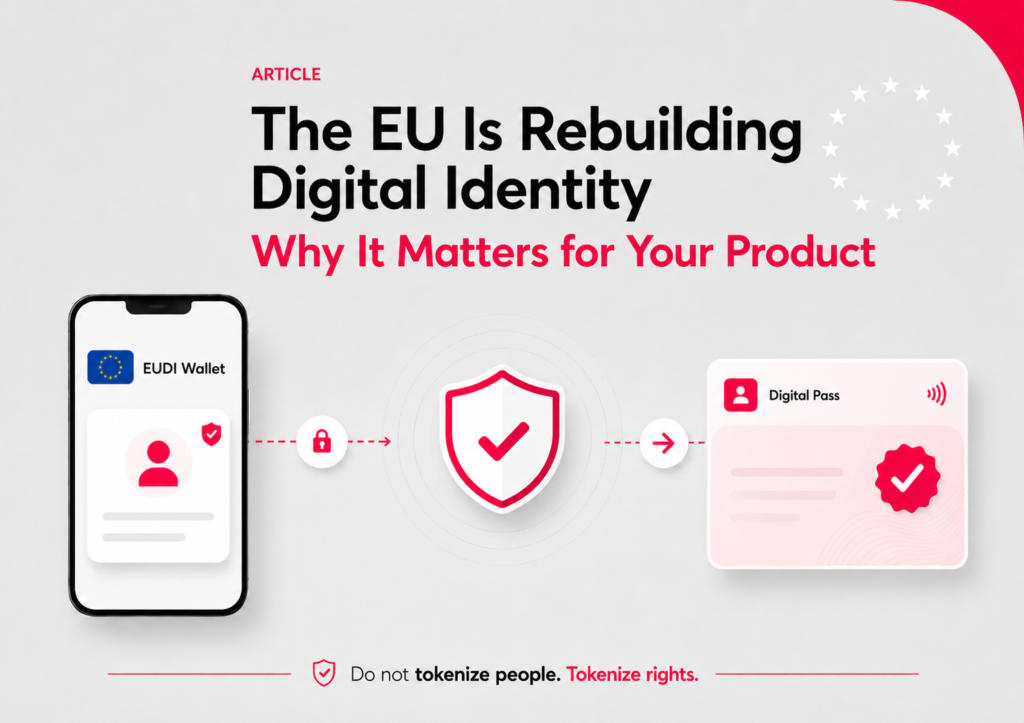
The EUDI Wallet is not a crypto wallet or a public identity token. It is Europe’s new trust layer for digital identity. Under the amended eIDAS framework (Regulation (EU) 2024/1183), every EU Member State must provide at least one certified EUDI Wallet to citizens and businesses by late 2026, with obligated private-sector organisations in regulated sectors required to accept it roughly a year later. For any company building digital products in or for the EU, this is not a distant policy item. It’s an architecture decision you’ll face soon. Gataca
“Most teams hear ‘digital identity’ and ‘blockchain’ in the same sentence and immediately ask the wrong question. The goal was never to put people on a ledger. The goal is to connect trusted identity to real business workflows.”
— Dominik Zyskowski, Consulting Director at Espeo Software
What the EUDI Wallet actually is
In simple terms, the EUDI Wallet is a place where a person, resident, or business can hold verified digital credentials: identity data, age, residency, qualifications, permits, company representation, or other official attributes.
This is where Verifiable Credentials become important. A Verifiable Credential is a digital statement that can be trusted because it’s issued by an authoritative source and can be cryptographically verified. It’s not a PDF, a scanned certificate, or a database record. It’s a credential that carries proof of who issued it, who it belongs to, and whether it has been changed or revoked.
Verification works through signature checks against keys published on trusted lists. Revocation is handled through status lists — not on-chain — and stays under user control. A government authority could issue a residency credential. A university could issue a qualification. A regulator could issue a permit. A company registry could prove that someone is authorized to represent a business.
So instead of uploading a passport scan, a utility bill, and three PDFs, a user could present a single verified proof from the wallet.
Why this matters for onboarding
Today, onboarding usually means collecting and storing too much, then manually checking documents — which creates cost, friction, and risk. The EUDI Wallet points to a different model:
- Verify the fact, not the document.
- Request less data.
- Make the business decision faster.
This privacy-by-design approach is built into the framework. Selective disclosure lets users prove specific facts, such as being over 18, without sharing their date of birth or full name. Deepidv
The wrong question: “How do we put identity on-chain?”
This is where many teams make the wrong jump. They hear “digital identity” and “blockchain” and immediately ask: “How do we put identity on-chain?”
That’s the wrong question.
Both public and private blockchains are poor places for personal identity. They’re permanent, which makes data hard to erase or revoke. And once you turn identity into a public token, you make future tracking easier, not harder.
The better question is: “What should verified identity unlock?”
“At Espeo, our view is simple. Do not tokenize people. Tokenize rights. The EUDI Wallet proves eligibility — and the product decides what happens next.”
— Dominik Zyskowski, Consulting Director at Espeo Software
That “next step” could be access to a service. A venue pass. A subsidy voucher. A permit. A delegated business permission. Or, in regulated finance, the right to participate in a specific investment product.
The architecture: verify, decide, then issue
The flow is straightforward:
- The user presents a credential from the EUDI Wallet.
- A verifier checks that the credential is real, valid, and not revoked.
- A policy engine applies the business rules — Is this person eligible? Is this company authorized? Is this investor allowed to access this product? Is this user in the right jurisdiction?
- Only then do you issue the right.
Sometimes that right should stay inside a normal business system. In other cases, it can become a token.
A concrete example: the event pass
First, the user presents Verifiable Credentials — proving, for example, that they’re over eighteen and resident in a certain country. The system verifies those credentials but does not need to store the underlying personal data.
Based on that verification, it issues a temporary, non-transferable, revocable digital pass. This pass is not the user’s identity, date of birth, or passport number. It simply says that this verified holder has the right to enter this venue under specific conditions.
At the venue, the user doesn’t reveal personal data again. They only prove they hold a valid pass. The system checks whether it’s authentic, unexpired, not revoked, and not already used. If those conditions are met, entry is granted.
This isn’t tokenization yet. It becomes a tokenized right only when that pass or entitlement is represented as a token on a shared ledger. Without that ledger layer, it’s a verifiable digital pass or a digital entitlement.
The distinction matters:
- A Verifiable Credential answers: “Does this person meet the requirements?”
- A digital pass answers: “Has this person been granted this specific permission?”
- A tokenized right answers: “Is that permission represented as a token that can be verified, transferred, restricted, revoked, or settled through a ledger?”
The same logic in regulated finance
In one regulated tokenization project Espeo worked on, the product was connected to [tokenized real estate investment — confirm detail level for public article]. The interesting part wasn’t issuing the token. That was the visible part. The real work was the system around it: investor onboarding, KYC and AML checks, wallet and custody flows.
Before anyone could hold the tokenized investment right, the platform needed to know whether they were allowed to participate — but the chain didn’t need to know who they were. The platform needed a reliable eligibility decision. That’s exactly where the EUDI Wallet becomes interesting.
In a European version of this product, today’s document checks could become wallet-based proofs: identity, residency, company authority, or investor status. Once eligibility is proven, the platform issues the right, and the token layer can enforce rules later. If a tokenized asset can only be held by eligible investors, the system can block transfers to wallets that haven’t passed the required checks.
The personal data stays off-chain. The enforcement result is reflected in the product layer. That’s the mature pattern — record only what the business actually needs.
Where engineering experience actually matters
Very few companies need to build their own EUDI Wallet. That’s not the opportunity. Every trust-list connection doesn’t need to be built from scratch. The opportunity is to design the product workflow around verified identity.
That means answering questions like: What credentials do we need? Who is the issuer? What data can we avoid collecting?
“A serious EUDI-enabled product is not a wallet login button. It’s the full product layer around the wallet — verification, business rules, fallback checks, payments, admin tools, auditability, and compliance controls. The demo is never the hard part. Production is.”
— Dominik Zyskowski, Consulting Director at Espeo Software
The hard part is making the flow work when a user fails verification, a document expires, a transaction is blocked, a regulator asks for evidence, or an operator needs to reverse or investigate something. That’s what production means — and it’s what Espeo has built across regulated fintech systems.
Start with the right question
The opportunity with the EUDI Wallet isn’t to “put identity on-chain.” It’s to connect trusted identity to real business workflows.
- For banks: smoother onboarding and stronger controls.
- For marketplaces: verified sellers, delegated permissions, restricted access.
- For tokenization platforms: regulated rights that can be issued, transferred, blocked, or revoked based on verified eligibility.
So if you’re exploring the EUDI Wallet, blockchain, or tokenized entitlements, don’t start with “Which chain?” Start with “What right are we issuing, and what needs to be enforced in production?”
That’s where the real design decisions live. The EUDI Wallet can prove eligibility — Espeo can help design what happens next.
Do not tokenize people. Tokenize the rights their verified identity unlocks.