Europe is entering a new phase in tokenized finance. For the last few years, most discussion focused on proofs of concept, regulatory sandboxes, and headline-grabbing digital bond issuances. In 2026, that is changing. The central question is no longer whether tokenization can work. It is which market design, settlement model, and legal framework Europe will use to make tokenized finance work at scale.
That shift matters because tokenization is starting to move closer to real market infrastructure. The ECB has now published the Appia roadmap and confirmed that Pontes is scheduled for launch in the third quarter of 2026. HM Treasury has selected HSBC for the UK’s DIGIT pilot. The Bank of England and FCA already have firms moving through the Digital Securities Sandbox. Meanwhile, the European Commission has signaled that the DLT Pilot Regime needs to evolve if Europe wants participation at meaningful scale.
Why 2026 feels different
The strongest signal is institutional behavior. Europe’s public authorities are no longer talking only about innovation in broad terms. They are making design choices about settlement, collateral, interoperability, and market structure. It’s what clearly shown in our State of DLT Report 2026.
The ECB has been especially clear about the problem it is trying to solve. In its March and April 2026 publications, it argued that tokenized markets in Europe will struggle to scale without two things: a trusted settlement anchor and a way to avoid fragmentation across DLT networks. Its 2024 exploratory work, which covered 50 trials across nine jurisdictions and roughly €1.6 billion in transactions, gave it enough evidence to move from experimentation to roadmap.
At the same time, the UK is using a different but complementary route. The DIGIT pilot and the Digital Securities Sandbox show a practical willingness to let real firms test real workflows in a regulated live environment. That matters because policy credibility grows when infrastructure, not just theory, is under construction.
The three systems Europe is building at once
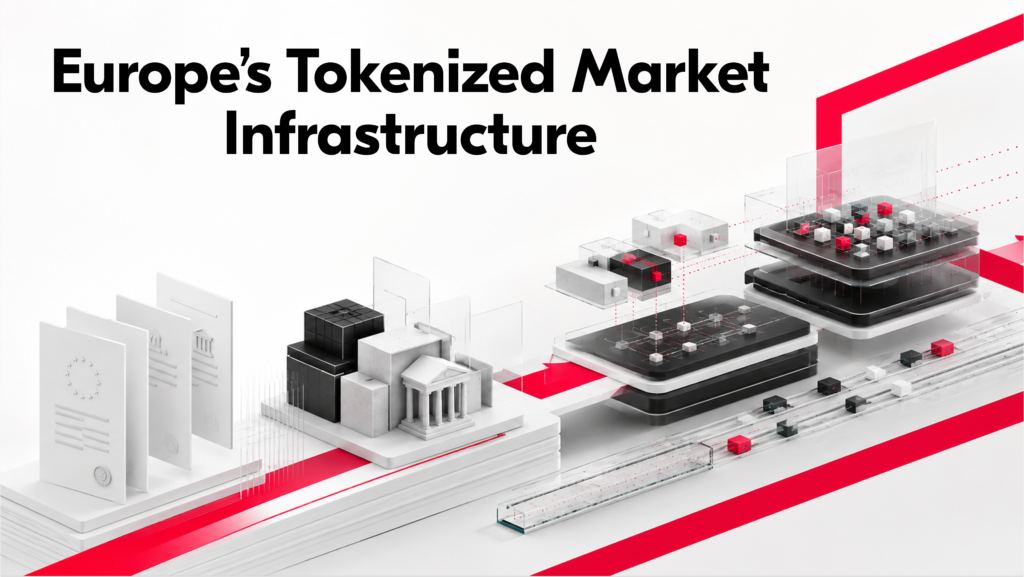
Europe is not building one tokenized market. It is building three connected layers.
First, it is building a settlement layer. The ECB’s Pontes initiative is meant to bring central bank money into DLT-based wholesale transactions. That matters because institutional markets still need a risk-minimized settlement asset, especially when securities, collateral, and cash move across multiple venues and counterparties.
Second, it is building market access pathways. The UK’s Digital Securities Sandbox is designed to let firms test issuance, trading, and settlement of digital securities in a live but supervised setting. As of February 2, 2026, the Bank of England said 16 firms were preparing to launch activity later this year.
Third, it is building the legal bridge from temporary experimentation to permanent market structure. The European Commission has already acknowledged that participation in the DLT Pilot Regime has been modest and has backed extending its scope and duration. That is an important admission. It suggests the next phase is not about proving that the technology exists, but about changing the rules so institutions can use it with less friction.
What is still blocking scale
The first blocker is fragmentation. Europe already has multiple tokenization efforts, but they do not automatically connect. Assets, settlement rails, and compliance logic can end up locked in separate systems. The ECB and AFME both now describe interoperability as a core requirement rather than a nice-to-have.
The second blocker is settlement asset design. Private solutions such as tokenized deposits and stablecoins will likely matter, but Europe’s official sector is making the case that they still need a trusted public anchor. The ECB’s view is straightforward: without central bank money connectivity, tokenized markets become harder to scale safely and consistently.
The third blocker is legal mismatch. Technology can streamline issuance, trading, settlement, and servicing, but it cannot harmonize insolvency law, corporate law, or securities treatment across Europe on its own. That is why Appia matters as a policy project, not just a technical one. The hard problem is no longer writing smart contracts. It is aligning legal certainty with digital workflows.
Why this matters for business and technology leaders
For banks, custodians, and market infrastructures, the takeaway is that tokenization strategy now needs to be tied to operating model decisions. Teams need to decide where they expect liquidity to concentrate, which settlement assets they will support, how they will connect to public infrastructure, and what level of interoperability they will require from partners.
For fintechs and software builders, the opportunity is shifting upward in the stack. Pure token issuance tooling may not be enough. The bigger value may sit in orchestration, compliance controls, lifecycle automation, collateral workflows, and connectivity between fragmented networks.
For enterprise decision-makers, the most important mindset change is this: tokenization is becoming an infrastructure planning issue. It now belongs in conversations about architecture, partnerships, and regulatory readiness, not just innovation labs.
A quick comparison of where Europe stands
| Area | What is happening now | Why it matters |
|---|---|---|
| ECB | Appia roadmap published; Pontes due in Q3 2026 | Creates a path for central-bank-money settlement on DLT |
| UK Treasury | HSBC chosen for DIGIT pilot | Pushes tokenized sovereign market infrastructure closer to execution |
| Bank of England/FCA | DSS progressing with firms in pipeline | Gives industry a live environment to test tokenized securities workflows |
| European Commission | DLT Pilot Regime seen as too limited in current form | Signals policy willingness to evolve beyond early-stage experimentation |
| Industry | AFME calling for interoperability and permanent reforms | Confirms the market sees architecture and rules as the next bottleneck |
What to watch next
The next 12 to 18 months will likely decide whether Europe turns early policy leadership into durable market leadership.
There are four things worth watching closely. First, whether Pontes launches cleanly and proves useful enough to shape market behavior. Second, whether the DLT Pilot Regime evolves into something institutions can use at broader scale. Third, whether the UK can turn DIGIT and the DSS into repeatable issuance and settlement patterns rather than isolated experiments. Fourth, whether Europe converges on interoperability standards quickly enough to avoid building a patchwork of disconnected tokenized markets.
Conclusion
Europe’s tokenized finance story is getting more serious. The market is moving away from pilot theater and toward choices about settlement, governance, legal design, and infrastructure coordination. That is exactly where the real long-term value will be created or lost.
For us at Espeo, the important point is not that tokenization is suddenly finished or inevitable. It is that the work has changed. The winning teams in this phase will be the ones that can translate policy direction into production-ready systems.
FAQ
What is Appia?
Appia is the ECB’s longer-term initiative to help shape a European tokenized financial ecosystem, with a blueprint expected in 2028.
What is Pontes?
Pontes is the ECB’s near-term DLT solution for settling tokenized wholesale transactions in central bank money, scheduled for Q3 2026.
What is DIGIT?
DIGIT is the UK government’s Digital Gilt Instrument pilot, with HSBC appointed as platform provider on February 12, 2026.
Why does interoperability matter in tokenized finance?
Because disconnected ledgers fragment liquidity, increase integration costs, and limit the ability to move assets and settlement value across systems.
What is the biggest risk for Europe right now?
The biggest risk is not lack of pilots. It is failing to turn those pilots into a scalable legal and infrastructure model before other markets pull further ahead.
Sources:
- ECB: Appia roadmap, March 11, 2026
- ECB speech: Building the rails for Europe’s tokenised financial markets, March 23, 2026
- ECB speech: Sparking the transformation of finance, April 15, 2026
- ECB: Comprehensive payments strategy, March 2026
- HM Treasury: HSBC appointed for DIGIT pilot, February 12, 2026
- UK government: tokenisation and future payments package, April 21, 2026
- European Commission: DLT and tokenisation, April 21, 2026
- Bank of England: Digital Securities Sandbox
- Bank of England: DSS dashboard, updated April 30, 2026
- AFME: DLT-Based Capital Market Report 2025 FY, February 24, 2026
- AFME: Future European DLT-based Financial Market Architecture, April 29, 2026