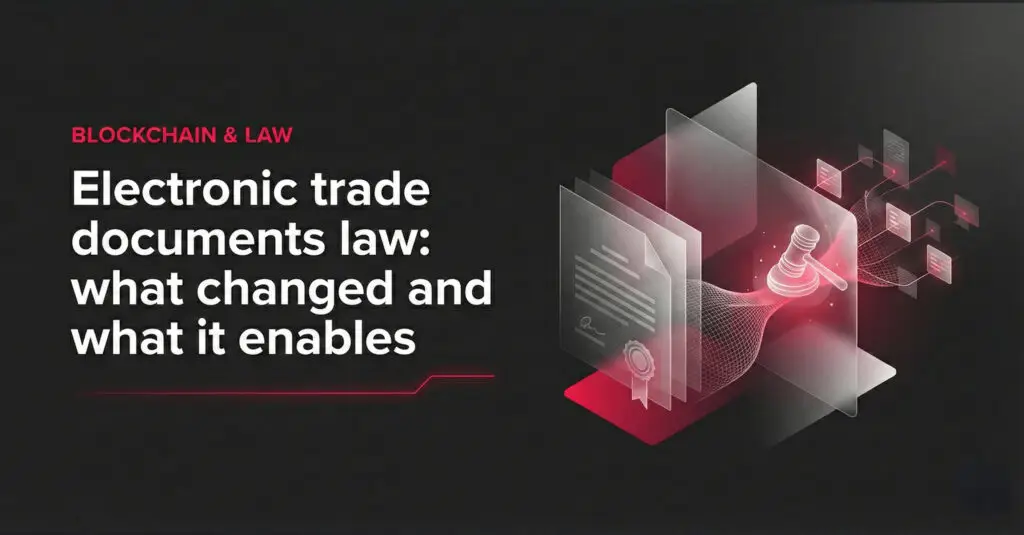
For decades, international trade has relied on physical documents – bills of lading, bills of exchange, promissory notes – as proof of ownership, authorization to move goods, and instruments for securing finance. These paper-based systems work, but they create friction: documents must be physically transported, couriers add cost and delay, and exceptions to proof-of-possession rules create legal uncertainty. When digital alternatives emerged, banks and traders found themselves in a legal grey zone. Could a digital bill of lading really replace the paper version? Could courts enforce contracts based on electronic documents? The answer depended entirely on jurisdiction-specific law – and most jurisdictions had no clear answer.
This legal ambiguity was the primary barrier to digital trade finance, not the technology itself. Blockchain systems, APIs, and data standards could all enable paperless trade, but none of that mattered if courts might reject a digital document as evidence or collateral. That is changing. In the last five years, major jurisdictions have passed new laws that extend legal recognition to electronic trade documents. These laws establish what lawyers call “functional equivalence” – the principle that a digital document can perform the same legal function as its paper equivalent. With this foundation in place, the path to digital-first trade finance is becoming legally viable.
In an episode of On The Block, Espeo Software’s YouTube series on blockchain and decentralized technology, this shift was examined in depth. The episode explores what has changed in the legal landscape, which documents are now recognized digitally, and what this enables for banks, carriers, and traders building the next generation of trade finance infrastructure. Visit Espeo’s website to learn more about their work in this space.
Why legal recognition is the foundation for digital trade
Before the recent wave of legislation, digitizing trade documents created a paradox. A company might implement a platform for exchanging electronic bills of lading with lower costs, faster settlement, and better auditability – all real operational benefits. But if a dispute arose and the case went to court, there was no guarantee the judge would accept the digital document as valid proof of ownership or obligation. The paper original still held legal weight that the digital copy did not.
This gap between operational capability and legal enforceability was not a small problem. It meant that even when digital alternatives were technically superior and economically rational, legal risk prevented widespread adoption. A bank could not confidently finance against an electronic bill of lading if the security interest might not hold up in court. A carrier could not move goods based solely on a digital manifest if local regulations required a paper original. Projects that offered genuine operational improvements often failed because they could not overcome legal uncertainty.
The core issue was that the law – especially commercial and evidence law in different countries – had evolved around physical documents. A “signature” meant a handwritten mark. A “document” meant something on paper. Possession of a document proved ownership in ways that a digital file, which can be copied infinitely, could not. These legal concepts worked well for a paper-based world, but they could not be simply transferred to digital systems without new rules.
The shift: UNCITRAL MLETR and national legislation
In 2017, the United Nations Commission on International Trade Law (UNCITRAL) adopted the Model Law on Electronic Transferable Records (MLETR). This was not a binding treaty, but rather a template that countries could adopt into their own legislation. The MLETR established a framework for recognizing electronic documents that perform the same legal function as paper originals – principally transferable records like bills of lading, bills of exchange, and promissory notes.
The MLETR’s core principle is “functional equivalence”: an electronic document can be treated as having the same legal effect as a paper document if it meets certain technical and governance criteria. Specifically, the law requires that:
- The system reliably identifies the issuer and holder of the document
- Only one entity can hold the document at any time (exclusive control)
- The document cannot be altered without detection
- The system is governed in a way that protects the interests of all parties
These requirements are technology-neutral. A blockchain network, a closed database, or a distributed ledger could all satisfy them – what matters is whether the system design ensures exclusive control, authenticity, and integrity.
Since MLETR was released, it has been adopted or adapted by a growing number of jurisdictions. The adoption is uneven – some countries have passed comprehensive legislation, others have modified existing laws, and still others have not yet acted. This fragmentation is important to understand for cross-border trade finance.
The UK Electronic Trade Documents Act 2023
The United Kingdom took a particularly clear approach. The Electronic Trade Documents Act 2023 received Royal Assent on 20 July 2023 and came into force on 20 September 2023. The Act explicitly recognizes electronic transferable records and grants them legal status equivalent to paper originals for a defined set of trade documents.
The Act covers:
- Bills of lading and equivalent documents
- Bills of exchange
- Promissory notes
- Warehouse receipts and other equivalent transport documents
The legislation is based on UNCITRAL MLETR principles, but it goes further in some respects by creating explicit statutory recognition rather than relying on model law adoption. This means that in UK law, an electronic bill of lading that meets the Act’s requirements – reliable system, exclusive control, integrity, and proper governance – is legally equivalent to a paper bill of lading for all purposes, including as evidence in court and as collateral for financing.
The practical implications are significant. A bank in the UK can now finance against an electronic bill of lading without additional legal risk compared to paper. A court will recognize the holder of an electronic document as the legal owner, provided the system’s design and governance meet the statutory criteria. Carriers can move goods based on digital documents without needing to produce a paper original for legal proof.
Key point: The UK Electronic Trade Documents Act does not require blockchain or any specific technology. What it does require is a reliable system with exclusive control mechanisms. This means traditional trade finance platforms, blockchain networks, and hybrid systems can all qualify if designed to meet the functional equivalence criteria.
Which documents are now legally recognized
One point of potential confusion: not all trade documents are covered by electronic transferable records legislation. The laws specifically target “transferable records” – documents that convey ownership or have a financial value that transfers from one holder to the next. These are fundamentally different from informational documents.
Documents that fall under electronic recognition laws:
- Bills of lading: The transport contract and proof of shipment. An electronic bill of lading (eBL) can now carry title and be pledged as collateral in jurisdictions with supporting legislation.
- Bills of exchange: A written order to pay a specific sum to a designated person on demand or at a specific date. These are negotiable instruments used widely in trade finance.
- Promissory notes: A written promise to pay a sum. Digital versions can now carry the same legal enforceability as paper.
- Warehouse receipts: Documents proving goods held in storage. Electronic versions can now serve as negotiable instruments.
Documents that typically remain outside this scope:
- Informational documents (invoices, packing lists, certificates of origin) – these do not need electronic recognition laws because they have never required physical form
- Generic contracts – these are governed by general contract law, not trade-specific legislation
- Some regulatory certificates – depending on jurisdiction, certain compliance documents may still require official paper originals
Functional Equivalence Explained
Functional equivalence is the legal principle that a digital document can perform the same legal function as a paper original. In trade finance, this means an electronic bill of lading can:
- Prove ownership of the goods
- Be transferred from one party to another
- Serve as collateral for bank financing
- Be accepted as evidence in court proceedings
The law does not care how the system is technically implemented – only that the system design reliably meets the functional requirements: exclusive control, authenticity, integrity, and governance.
The cross-border reality: adoption is uneven
Legislation recognizing electronic transferable records is spreading, but adoption remains uneven across major trading jurisdictions. Some countries have passed comprehensive laws; others are still in the process of legislative reform; and a few have not yet moved forward. This creates a fragmented global landscape.
For example:
- The United Kingdom passed dedicated legislation (Electronic Trade Documents Act 2023)
- Singapore has adapted its Bills of Lading Act to recognize electronic documents
- South Korea and Japan have legislative frameworks in progress or recently enacted
- The European Union has not yet passed unified legislation on electronic transferable records, though member states vary in their approach
- Many jurisdictions are still reviewing UNCITRAL MLETR or have not yet acted
This unevenness matters because trade is global. A shipment routed through multiple jurisdictions with different legal frameworks creates complexity. A digital bill of lading might be recognized in the UK and Singapore but face uncertainty in another port jurisdiction. This is why industry initiatives, cross-border agreements, and contractual mechanisms are essential – they can bridge gaps in national law.
“Many early projects tried to digitise documents that, in law, still had to be on paper. If this is your case, I would suggest shifting your focus towards supporting councils and associations that lobby for standardisation initiatives on the global stage.”
– Przemysław Koper, CEO at Espeo Software
For organizations operating in multiple jurisdictions, the strategic response is to work with trade associations, chambers of commerce, and standards bodies that advocate for broader adoption of electronic trade document legislation. This is not a short-term fix, but it is how the legal infrastructure gradually catches up with technology and operational reality.
What this unlocks for banks and financing
The practical unlock is straightforward: banks can now finance against electronic trade documents with significantly less legal risk. In a traditional paper-based system, a bank lending against a bill of lading must hold the physical document as security. This creates operational burden – the document must be physically stored, insured, and transferred when the loan is repaid or the goods change hands. The process is slow and costly.
With legal recognition of electronic documents, banks can take security interests in electronic bills of lading and other digital records. The security mechanism is enforced by the system design (exclusive control, immutability) rather than by physical custody. This means:
- Faster settlement: Documents can be transferred instantly, not moved by courier or mail
- Lower operational cost: No need for physical storage, insurance, or courier services
- Greater confidence: Banks can finance against these documents knowing the court will recognize their security interest
- Real-time visibility: Digital systems can provide live tracking of which party holds the document and what encumbrances exist against it
“Banks can finance against them with more confidence. Carriers and shippers can move away from paper without fearing that the judge will throw out the case.”
– Przemysław Koper, CEO at Espeo Software
This is not just about blockchain or distributed ledgers. Any system that meets the functional equivalence requirements can qualify. A proprietary platform operated by a trade finance consortium, a closed network managed by a shipping association, or a decentralized blockchain network could all serve as the underlying technology. The law cares about outcomes and governance, not implementation.
The role of standards and contracts
Law establishes the foundation, but standards and contracts fill in the operational detail. Even with favorable legislation, parties need to know what data should be included in an electronic bill of lading, how it should be structured, and how different systems can exchange information reliably.
Industry standards have evolved to address this. Specifications exist for the data fields that must be present in key trade documents, how they should be formatted, and how different platforms can interoperate. When organizations implement electronic trade documents, these standards become the practical bridge between legal recognition and operational reality.
“Industry standards have matured. We now have fairly detailed standards for what data should be inside key trade documents.”
– Przemysław Koper, CEO at Espeo Software
Contracts also matter. Even in a jurisdiction with favorable legislation, the contractual terms governing a digital trade document – what system will be used, who controls it, what happens if the system fails, how disputes are resolved – should all be clearly specified. Good contract drafting reduces operational friction and ensures all parties understand their rights and obligations.
For practitioners building or evaluating digital trade finance platforms, the implication is clear: choose technologies and standards that are aligned with industry norms. Proprietary or non-interoperable solutions create lock-in and limit participation. Open standards and interoperability reduce switching costs and encourage broader adoption.
Governance matters as much as technology
One theme emerges repeatedly from organizations that have successfully implemented electronic trade documents: governance is at least as important as the underlying technology. Who controls the network, how decisions are made, and what incentives exist for different participants all shape whether a system gains adoption.
“Governance beats technology. Who controls the network matters as much as what runs under the hood.”
– Przemysław Koper, CEO at Espeo Software
This principle applies whether the underlying system is blockchain-based, cloud-hosted, or traditional. A technically sophisticated platform will fail if banks do not trust the entity that controls it, or if governance is opaque. Conversely, a simpler technology can succeed if governance is fair, transparent, and aligns incentives across participants.
For digital trade documents specifically, governance questions include:
- Who operates the system and what prevents them from acting arbitrarily?
- How is downtime or failure handled? What is the recovery mechanism?
- Who has access to transaction data and under what circumstances?
- How are disputes between parties resolved?
- Is governance decentralized or centralized, and what are the trade-offs?
These are not technical questions, but they are foundational to whether a system will be trusted and adopted at scale.
The path forward: networks of networks
No single platform will dominate global trade finance. Instead, the future is likely to be a network of networks – multiple systems, potentially using different technologies and operated by different entities, all connected through common standards and protocols.
“We will see a network of networks.”
– Przemysław Koper, CEO at Espeo Software
This fragmentation might seem inefficient, but it reflects reality. Different regions, industries, and companies have different requirements, existing relationships, and technical capabilities. A unified global platform is not feasible. But a set of interconnected systems that can communicate and recognize each other’s documents is both achievable and desirable – it preserves choice while enabling interoperability.
For organizations evaluating how to participate, this means:
“Don’t wait for one magic platform. Instead, look for focused tools that can plug into the systems you already have. Start with the documents and risks that matter most to your business. And make sure whatever you build or buy is based on open standards and can interoperate.”
– Przemysław Koper, CEO at Espeo Software
Rather than betting on a single platform or waiting for one to emerge, successful organizations are building or adopting targeted solutions for their highest-friction areas and ensuring those solutions integrate with existing systems and follow open standards. This approach is pragmatic and reduces risk.
When can electronic documents deliver the most value
Legal recognition of electronic documents enables change, but it does not force it. Organizations need to identify where the operational and financial case is strongest.
High-value scenarios for electronic trade documents:
- Repetitive, high-volume routes: If your company ships the same lane repeatedly (e.g., China to Rotterdam), digitizing documents on that route creates proportionally larger efficiency gains
- Multiple parties and complex financing: Transactions involving many banks, guarantors, and intermediaries benefit most from digitized settlement and reduced paper movement
- Just-in-time supply chains: Inventory-intensive operations where timing matters significantly benefit from faster document settlement
- Emerging markets with high paper costs: Jurisdictions where physical couriers are expensive or unreliable see the greatest operational and cost benefits
Lower-value scenarios (where digital may not be justified yet):
- Low-volume, ad-hoc shipments where setup cost exceeds savings
- Jurisdictions where legal recognition is weak and contractual protection is difficult
- Routes where a single carrier or platform dominates and lacks incentive to change
The strategic insight is to match implementation scope to business value. Do not attempt to digitize everything at once. Instead, focus on the documents and trade lanes where the case is strongest, prove value, and expand from there.
Readiness checklist: what to assess
Legal and Regulatory Readiness
- Confirm that electronic trade documents are recognized in all relevant jurisdictions for your transactions (consult legal counsel on this point – this is not legal advice)
- Review your existing contracts to identify any clauses that require paper originals and update them to permit electronic alternatives
- Assess whether insurance policies for cargo and liability cover electronic documents or require explicit amendment
- Determine whether your banking partners are authorized to lend against electronic collateral under their regulatory framework
Operational and Technical Readiness
- Identify your highest-friction trade lanes and document types – these are your pilots
- Evaluate potential platforms against criteria: open standards, interoperability, governance transparency, and integration capability with your existing systems
- Confirm that any platform meets the functional equivalence requirements (exclusive control, authenticity, integrity) under the laws applicable to your transactions
- Plan for hybrid operations – assume you will run paper and digital processes in parallel for an extended period
Stakeholder and Governance Readiness
- Engage your banking partners early – they must be comfortable with the platform’s governance and reliability
- Coordinate with trading partners and carriers – adoption requires participation from multiple parties
- Join relevant industry groups and standards bodies to influence development and align with peers
- Understand the governance model of any platform you adopt – verify it protects your interests and provides fair dispute resolution
Frequently Asked Questions
UNCITRAL MLETR stands for the United Nations Commission on International Trade Law’s Model Law on Electronic Transferable Records. It is a template framework adopted by UNCITRAL in 2017 that countries can adopt into their own legislation to recognize electronic documents (such as bills of lading, bills of exchange, and promissory notes) as having the same legal effect as paper originals. It is not binding on countries, but it provides a consistent approach that has been adopted or adapted by a growing number of jurisdictions.
The UK Electronic Trade Documents Act 2023 explicitly recognizes electronic versions of bills of lading, bills of exchange, promissory notes, and equivalent transport documents as legally equivalent to paper originals. This means an electronic bill of lading can be used as evidence in court, can be transferred from one party to another, and can serve as collateral for bank financing, provided the system meets the statutory requirements for exclusive control, authenticity, and integrity.
The UK Electronic Trade Documents Act 2023 received Royal Assent on 20 July 2023 and came into force on 20 September 2023. From that date, electronic transferable records meeting the Act’s requirements are recognized in UK law as having the same legal status as paper originals.
In jurisdictions with legislation recognizing electronic transferable records – including the UK, Singapore, and others – electronic bills of lading are legally valid and enforceable provided they are issued and held on a system that meets the statutory requirements for exclusive control, authenticity, and integrity. However, legal validity varies by jurisdiction, so you should confirm the position in the jurisdictions relevant to your transactions.
Yes, in jurisdictions with supporting legislation, banks can take security interests in electronic trade documents. The electronic document serves as collateral in the same way a paper document does. The bank’s security interest is enforced by the system design (exclusive control of the document) rather than by physical custody. This enables faster, lower-cost financing arrangements compared to traditional paper-based processes.
Industry standards specify what data should be included in electronic trade documents and how that data should be formatted. Standards also define how different systems should interoperate, enabling a digital document created on one platform to be recognized and used on another. By aligning to open standards rather than proprietary formats, organizations reduce switching costs and ensure that digital documents will be compatible across multiple jurisdictions and platforms.
Further Reading
- UNCITRAL Model Law on Electronic Transferable Records (MLETR) – Full Text – The official UNCITRAL model law document. Essential reading for understanding the international framework and the functional equivalence principle.
- UK Electronic Trade Documents Act 2023 – Legislation – The full statutory text of the UK Act. Provides the specific UK legal framework for electronic transferable records and the documents they cover.
- UK Law Commission – Trade Law Project – The Law Commission’s ongoing work on modernizing UK trade law, including the background and rationale for the Electronic Trade Documents Act.
- ICC Digital Standards Initiative – The International Chamber of Commerce’s work on harmonizing standards for digital trade documents and platforms. Includes guidance on best practices for governance and interoperability.
- UNCITRAL Electronic Commerce Working Group – Ongoing UNCITRAL initiatives on electronic commerce and transferable records, tracking legislative developments across member states.
- Trade Documentation Standards (ISO 20022, UN/EDIFACT) – International standards for the structure and content of trade documents. Essential for ensuring compatibility across systems and jurisdictions.
This post is based on an episode of On The Block, Espeo Software’s series on blockchain and decentralised technology. Direct quotes have been lightly edited for readability.