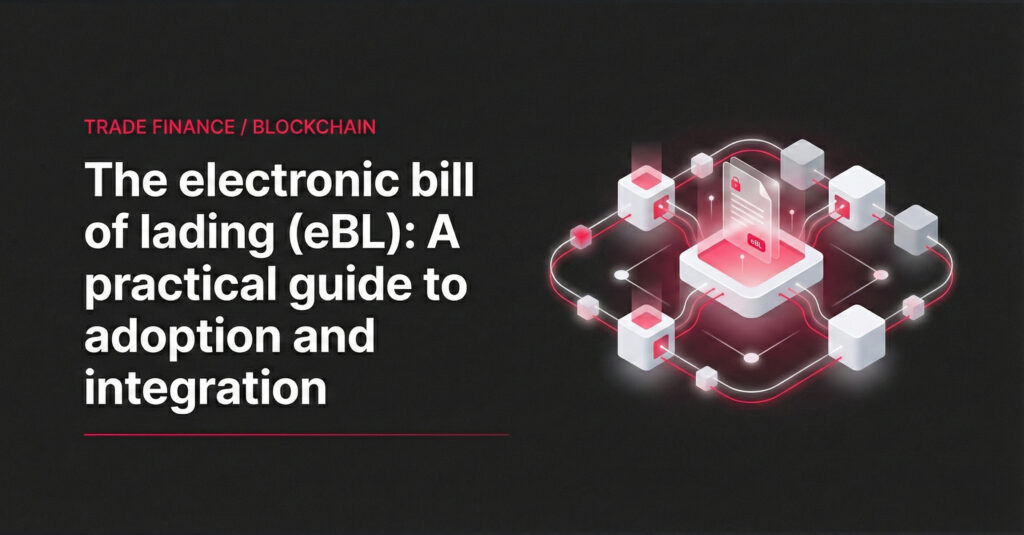
The electronic bill of lading (eBL) is quickly becoming the focal point of trade digitisation. Today, trade finance still runs on paper: letters of credit, invoices, certificates and bills of lading move between banks, carriers, buyers, sellers and customs authorities as physical documents or static PDFs. They travel slowly, they get lost, and they can be forged. The bill of lading sits at the centre of this paper chain because it proves who controls the cargo. As a result, digitising this single document has the potential to reshape how goods cross borders and how banks finance that movement.
After years of ambitious but often unsuccessful attempts to build one shared blockchain platform for all of trade, the industry now takes a different approach. Instead of trying to digitise everything at once, carriers, banks and standards bodies focus on making the electronic bill of lading digital in a legally robust way. Major ocean carriers have committed to reaching 100% eBL adoption by 2030, new laws in key jurisdictions now recognise electronic trade documents, and interoperability standards keep maturing. Consequently, the question is no longer whether eBLs will replace paper, but how quickly organisations can integrate them.
This guide draws on an episode of On The Block, Espeo Software‘s series on blockchain and decentralised technology, which examined where blockchain in trade finance has succeeded and where it has stumbled. We expand on the video’s analysis with current data from the Digital Container Shipping Association (DCSA), the FIT Alliance, and recent legislative developments to produce a practical reference for shipping lines, banks and corporates planning electronic bill of lading adoption.
What is an electronic bill of lading and why does it matter?
A bill of lading (BoL) is one of the oldest documents in international trade. It serves three functions at once: it acts as a receipt confirming the carrier has received the goods, it records the terms of carriage, and – most importantly – it functions as a document of title. In other words, whoever holds the original bill of lading has the legal right to claim the cargo. This is why the phrase “control the bill, control the cargo” is so central to trade finance.
An electronic bill of lading replicates all three functions in digital form. However, the critical challenge in moving from paper to digital is reproducing the concept of possession. A paper bill is a physical object: if you hand it to someone, you no longer have it. Similarly, an eBL must ensure that only one party controls the document at any time, that nobody can duplicate it, and that control transfers fully (divests) when the document moves to the next party.
Paper BoL: Physical document, typically issued in three originals. Moves by courier between parties. Takes days to arrive. Can be lost, delayed or forged. Must physically change hands to transfer title.
Electronic BoL (eBL): Digital record on a platform that enforces exclusive control. Transfers in minutes. Cannot be duplicated or altered without detection. Carries the same legal weight as paper in jurisdictions that recognise electronic trade documents.
“If you control the bill of lading, you control the cargo. It is central to trade and to trade finance.”
– Przemyslaw Koper, CEO at Espeo Software
The scale of the paper problem
Ocean carriers issue roughly 45 million bills of lading each year. As recently as 2021, only about 1.2% of these took electronic form. The costs of the paper-based system are substantial: industry estimates suggest that switching entirely to eBLs could save $6.5 billion in direct costs and enable $30-40 billion in additional annual global trade growth by removing document-related friction.
How the electronic bill of lading fits into trade finance workflows
To understand why the eBL matters so much, consider how a bill of lading moves through a typical trade transaction. First, a shipper loads goods onto a vessel and the carrier issues a bill of lading. Next, the shipper sends the original bill to the buyer or to a financing bank. The bill may then pass through intermediary banks, freight forwarders and agents. Finally, at the destination port, whoever presents the original bill of lading can claim the goods.
Why banks depend on the bill of lading
In trade finance, this chain becomes even more complex. When a bank finances a shipment – for example, by issuing a letter of credit or discounting a receivable – it relies on the bill of lading as collateral. The bank needs confidence that it holds the genuine original, that no other party has a competing claim, and that the document will hold up in court. However, when these documents travel as paper, delay, loss and fraud remain real risks. Cargo sometimes arrives at the destination before the paper bill does, forcing parties to use letters of indemnity – a workaround that creates additional exposure.
Digitising the bill of lading addresses these problems directly. With an electronic bill of lading, the document moves between parties in minutes rather than days. Banks verify in real time that they hold the only valid copy, and the audit trail stays complete and tamper-resistant. Still, achieving these benefits depends on every party in the chain – shipper, carrier, bank, buyer, freight forwarder – being able to work with the same digital document.
eBL adoption targets: carrier commitments and the road to 2030
The strongest signal that electronic bill of lading adoption keeps accelerating comes from the carriers themselves. In February 2023, the nine DCSA member carriers – including MSC, Maersk, CMA CGM, Hapag-Lloyd, ONE, Evergreen, Yang Ming, HMM and ZIM – signed a public commitment to convert 50% of their bills of lading to digital within five years and 100% by 2030, based on DCSA standards.
This commitment matters because when the companies that physically move cargo change how they operate, every other party in the chain must adapt. In practice, banks, freight forwarders, customs authorities and insurers will all need to handle eBLs once carriers stop issuing paper.
What the FIT Alliance survey data shows
The FIT Alliance – a cross-industry coalition co-founded by BIMCO, DCSA, FIATA, the International Chamber of Commerce (ICC) and SWIFT – tracks adoption progress through regular surveys. Its 2024 survey, conducted with the Boston Consulting Group (BCG) and the HKUST Li & Fung Supply Chain Institute, found that overall eBL adoption rose from 33% of respondents in 2022 to roughly 49% in 2024. Moreover, nearly three-quarters of firms still using only paper said they plan to transition. In the bulk shipping sector, a BIMCO campaign targeting 25% eBL usage for iron ore shipments by 2025 hit its target early, reaching 25.1% by mid-2024.
“Carriers and standard-setting bodies have now made strong public commitments to move to eBLs. They have set targets to reach high levels of eBL adoption by 2030.”
– Przemyslaw Koper, CEO at Espeo Software
Uneven adoption across the supply chain
Despite this momentum, adoption remains uneven. Terminals and carriers lead with rates above 73%, while banks lag at just 21% adoption despite 82.5% awareness. Freight forwarders face challenges on both awareness and uptake. This gap highlights a coordination problem: because an electronic bill of lading must flow through the hands of many parties, a single participant that cannot accept it breaks the chain.
How electronic bill of lading issuance, transfer and surrender works
The lifecycle of an eBL mirrors its paper equivalent, but the mechanisms differ. Understanding this workflow is essential for anyone planning eBL integration.
(control moves exclusively – shipper is divested) ↓ Onward transfer(s) to consignee / endorsee ↓ Surrender to carrier at destination
(eBL is accomplished – goods released)
Issuance
The carrier creates the eBL on an approved platform. Data fields – shipper, consignee, goods description, vessel details, port of loading and discharge – follow standards such as the DCSA bill of lading data model. Once issued, the shipper receives exclusive control of the digital document.
Transfer
When the shipper transfers the electronic bill of lading – for example, to a bank providing trade finance, or directly to the buyer – control moves exclusively. As a result, the transferor can no longer access or transfer the document. This replicates the physical handover of a paper bill, and each transfer appears in an immutable record.
Surrender
At the destination, the holder surrenders the eBL back to the carrier (or its agent) to claim the goods. Once surrendered, the platform marks the eBL as “accomplished” and blocks any further transfer. The carrier then releases the cargo to the presenting party.
Some eBL platforms use blockchain to enforce exclusive control, divestment and immutability. Others rely on different technological approaches. Importantly, the legal frameworks discussed below are deliberately technology-neutral, so different solutions can compete on features and performance.
Interoperability standards for the electronic bill of lading
One of the most persistent barriers to eBL adoption has been platform fragmentation. Several eBL solution providers operate in the market, each with its own technology, rules and onboarding requirements. If the shipper uses platform A, the consignee platform B, the trade finance bank platform C and the carrier platform D, the eBL simply cannot flow between them – defeating the purpose of digitisation.
“If every platform has its own data model and its own way to represent a bill of lading or an invoice or a certificate, then each integration is a mini-project. The industry has learnt that we first need shared standards for data and for APIs.”
– Przemyslaw Koper, CEO at Espeo Software
What interoperability requires
Solving this problem demands three components working together. First, common data standards must define what fields an eBL contains and how they are structured. Second, standard application programming interfaces (APIs) must specify how platforms exchange electronic bill of lading data. Third, a tracking mechanism must log which platform currently controls each eBL at any point in time.
DCSA develops open-source standards for exactly this purpose. Its bill of lading data standard defines required fields and data formats, while its API specifications describe how systems request, issue, transfer and surrender eBLs programmatically. In May 2025, DCSA completed a landmark standards-based interoperable eBL transaction. During this pilot, carrier HMM issued an eBL that moved between two different solution providers (CargoX and edoxOnline) during a real shipment for Suzano. The transaction used a Control Tracking Registry (CTR) to log which platform controlled the eBL at each stage.
Choosing an eBL provider
For organisations evaluating providers, interoperability should rank as a primary selection criterion. A platform that supports DCSA standards and can exchange eBLs with other compliant platforms reduces vendor lock-in risk and maximises the number of counterparties you can transact with digitally.
The industry is not converging on a single global platform. Instead, a network of networks is taking shape: some focused on documents, some on fraud and risk checks, some on payments and settlement. These networks connect through shared standards and APIs. This model avoids the governance failures that brought down earlier one-platform-for-everything initiatives.
eBL integration patterns for banks and corporates
For banks and corporates, electronic bill of lading adoption goes beyond choosing a platform. It means integrating eBL workflows into existing trade finance and enterprise resource planning (ERP) systems. The practical question is: how does an eBL plug into the systems you already run?
API-first integration
Modern eBL platforms expose their functionality through APIs. A bank’s trade finance system can call these APIs to check eBL status, initiate transfers, verify title or surrender the document at the destination. As a result, eBL handling fits into existing operational workflows without requiring staff to switch to a separate interface for each transaction.
Identity and access control
Every party that touches an eBL must be reliably identified. eBL platforms use identity and authorisation models to verify that the person or system requesting a transfer has permission to do so. Consequently, banks need to map these requirements to their own know-your-customer (KYC) and access control frameworks. This mapping is often one of the more time-consuming parts of integration.
Audit and compliance
One clear advantage of eBLs over paper is the audit trail. Every action – issuance, transfer, amendment, surrender – gets recorded with timestamps and party identities. Banks can use this trail for compliance reporting, dispute resolution and internal audit. Meanwhile, corporate treasury teams can track document status in real time, reducing the uncertainty that comes with waiting for paper to arrive.
“Don’t wait for one magic platform. Instead, look for focused tools that can plug into the systems you already have. Start with the documents and risks that matter most to your business.”
– Przemyslaw Koper, CEO at Espeo Software
Lessons from fraud prevention tools
The On The Block episode also highlighted a parallel development in fraud prevention. Blockchain-based registries now allow banks to check whether a shipment or invoice has already been financed elsewhere, addressing the duplicate financing problem. These services connect through existing banking networks and APIs such as SWIFT, without requiring banks to join a new platform. This offers a useful model for eBL integration as well: connect through standards and APIs, not through platform-specific onboarding.
Legal recognition of the electronic bill of lading
For much of eBL history, the biggest obstacle was not technology but law. Under English common law, electronic documents could not be “possessed” – and possession is the mechanism by which a bill of lading transfers title to goods. Without legal recognition, banks could not confidently finance against eBLs, and holders could not be certain that courts would enforce their rights.
However, this situation has changed substantially in the past few years.
UK Electronic Trade Documents Act 2023 (ETDA)
The ETDA came into force on 20 September 2023. It allows electronic trade documents – including bills of lading, bills of exchange, promissory notes, ship’s delivery orders and warehouse receipts – to be possessed, endorsed and transferred with the same legal effect as their paper counterparts. To qualify, the document must sit on a “reliable system” that ensures it can be distinguished from copies, protected against unauthorised alteration, and controlled by only one party at a time. Notably, the Act is technology-neutral: it does not mandate or endorse any specific platform.
UNCITRAL Model Law on Electronic Transferable Records (MLETR)
Adopted by the United Nations Commission on International Trade Law in 2017, the MLETR provides a model legislative framework that countries can use to recognise electronic transferable records. It rests on three principles: technology neutrality, functional equivalence (electronic documents serve the same legal function as paper), and non-discrimination between electronic and paper forms. So far, 11 jurisdictions have adopted legislation based on or influenced by the MLETR, including Bahrain (the first, in 2018), Singapore, the United Kingdom and France. Meanwhile, Germany, Japan and other G7 members are at various stages of consideration.
APEC declaration and cross-border enforceability
In November 2024, leaders of the Asia-Pacific Economic Cooperation (APEC) economies – covering more than 60% of global trade – signed a declaration committing to enable and promote eBL use, including by aligning legal frameworks with MLETR.
This section provides a general overview of relevant legislation and is not legal advice. The enforceability of any specific electronic bill of lading depends on the governing law of the transaction, the reliability of the platform, and the legal position in all relevant jurisdictions. Organisations should consult qualified legal counsel before relying on eBLs as collateral or title documents.
Despite these advances, cross-border enforceability remains uneven. An eBL governed by English law now has recognition under the ETDA, but if the goods must be released in a jurisdiction without equivalent legislation, the holder may need to convert the eBL back to paper. Research conducted in 2024 by DCSA with Baker McKenzie found that electronic bill of lading use is possible in all 15 largest container trade corridors surveyed – but the legal basis varies, and contractual arrangements are still often needed where statutory recognition does not yet exist.
An electronic bill of lading readiness checklist
The most consistent lesson from the past decade of blockchain in trade finance is that focused, incremental adoption works better than trying to digitise everything at once. The eBL serves as the entry point – a single, high-value document that the industry is rallying around. Below is a practical readiness checklist for organisations planning electronic bill of lading adoption.
“Projects that focus on one thing, like the bill of lading or duplicate financing, are easier to explain, easier to integrate, and easier to justify in a business case.”
– Przemyslaw Koper, CEO at Espeo Software
For carriers
- Confirm which eBL solution providers your organisation supports or plans to support, and verify their alignment with DCSA standards and IGP&I Club approval.
- Define your internal data mapping from existing booking and shipping instruction systems to the DCSA bill of lading data model.
- Select a pilot corridor – ideally one where the legal environment supports eBLs and where key customers are willing to participate.
- Set up a change management programme for documentation teams, covering training on issuance, transfer and surrender workflows.
For banks
- Assess your trade finance platform’s readiness to receive and manage eBLs via API, including title verification, pledge and release workflows.
- Review your legal framework: can you accept an electronic bill of lading as collateral under the governing law of your transactions? Engage legal counsel on the ETDA, MLETR and equivalent legislation in your key corridors.
- Map identity and access control requirements: how will you onboard counterparties onto eBL platforms while staying compliant with KYC and anti-money-laundering rules?
- Start with a small number of transactions on a single corridor with a willing carrier and corporate client, then measure processing time, cost and error rates against your paper baseline.
For shippers and corporates
- Identify the trade corridors and counterparties where eBLs can deliver the most value – typically high-volume routes with trusted partners.
- Check whether your freight forwarders and banks can already handle eBLs, or plan a joint pilot.
- Confirm that your ERP and trade management systems can receive structured eBL data via API, or plan the integration work needed.
- Define internal controls, approval workflows and audit requirements for eBL transactions – these should mirror your paper-based controls, adapted for digital.
Across all roles, two principles apply. First, build on open standards (DCSA data models and APIs) so that your investment avoids lock-in to a single vendor. Second, plan for a period of dual operation: paper and electronic will co-exist for some time, and your processes need to handle both.
Frequently Asked Questions
An electronic bill of lading (eBL) is a digital equivalent of the paper bill of lading – the document that proves title to goods in transit. Like its paper counterpart, the eBL functions as a receipt for shipped goods, evidence of the contract of carriage, and a document of title. Its lifecycle includes issuance by the carrier, transfer between parties (shipper, bank, buyer), and surrender at the destination to release the cargo. Only one party can control the eBL at any time, and control must fully transfer on each handover.
The nine DCSA member carriers committed in February 2023 to reaching 50% electronic bill of lading adoption within five years and 100% by 2030, based on DCSA standards. However, full adoption depends on readiness across the entire supply chain, including banks, freight forwarders, customs authorities and corporates. Adoption will vary by trade corridor, with some routes reaching high digital penetration well before others. As of early 2025, approximately 5.7% of container trade bills of lading took digital form.
Yes. The UK Electronic Trade Documents Act 2023 (ETDA), which came into force on 20 September 2023, gives electronic trade documents – including bills of lading – the same legal status as their paper equivalents, provided a “reliable system” meets specified criteria. The Act is technology-neutral and does not endorse any specific platform. Organisations should consult legal counsel for advice on specific transactions, particularly where goods are released in jurisdictions with different legal frameworks.
Banks finance against an electronic bill of lading in broadly the same way they finance against a paper bill – by taking control of the document as collateral. The eBL platform enforces exclusive control, so the bank can verify it holds the only valid version and that no other party has a competing claim. In jurisdictions that have adopted legislation aligned with MLETR or the UK ETDA, eBLs can function as pledgeable title documents. Banks should assess their trade finance platform’s API readiness and engage legal counsel on enforceability in relevant corridors.
Electronic bill of lading interoperability requires three components: a common data standard (such as the DCSA bill of lading data model), standard APIs for exchanging eBL data between platforms, and a tracking mechanism – such as DCSA’s Control Tracking Registry – to log which platform controls each eBL at any given time. In May 2025, DCSA completed a standards-based interoperable eBL transaction across two different solution providers, showing that eBLs can move between platforms without requiring all parties to use the same system.
An electronic bill of lading implementation plan should cover corridor selection (choosing a route with willing counterparties and supportive legal frameworks), platform evaluation (checking DCSA standards alignment and interoperability), integration planning (API connections to trade finance or ERP systems), identity and access control setup, internal controls and audit procedures, and change management for affected teams. Most organisations start with a small pilot on a single corridor, measure results against paper-based baselines, and then scale to additional routes.
Further reading
- DCSA – 100% eBL commitment by 2030 – Details of the carrier commitment, FAQ and supporting resources from the Digital Container Shipping Association.
- DCSA – Electronic Bill of Lading standard – Open-source data standards and API specifications for eBL issuance, transfer and surrender.
- DCSA – Booking and Bill of Lading adoption guide – Step-by-step guidance for implementing DCSA eBL standards, including the latest FIT Alliance survey results.
- UK Electronic Trade Documents Act 2023 – Explanatory Notes – Official legislative text and explanatory notes from the UK Parliament.
- Law Commission – Electronic trade documents – The Law Commission’s report and recommendations that led to the UK ETDA.
- UNCITRAL – Model Law on Electronic Transferable Records (MLETR) – Full text and guide to enactment of the MLETR, adopted in 2017.
- UNCITRAL – MLETR adoption status – Current list of jurisdictions that have enacted legislation based on or influenced by the MLETR.
- FIT Alliance – The cross-industry coalition (BIMCO, DCSA, FIATA, ICC, SWIFT) driving eBL adoption, including survey reports and the eBL Declaration.
- Espeo Software – Blockchain consultancy specialising in payments, asset tokenisation and DLT projects for trade finance.
This post is based on an episode of On The Block, Espeo Software’s series on blockchain and decentralised technology. It has been expanded with additional research and analysis covering DCSA commitments, FIT Alliance survey data and legislative developments. Direct quotes have been lightly edited for readability.